Impact of monetary compensation for untaken vacation
How the vacation compensation you receive affects your right to benefits depends on whether your employment is considered full-time or part-time. The duration of your employment relationship also impacts your right to benefits.
Vacation compensation paid on the basis of full-time work postpones the starting date for unemployment allowance payments
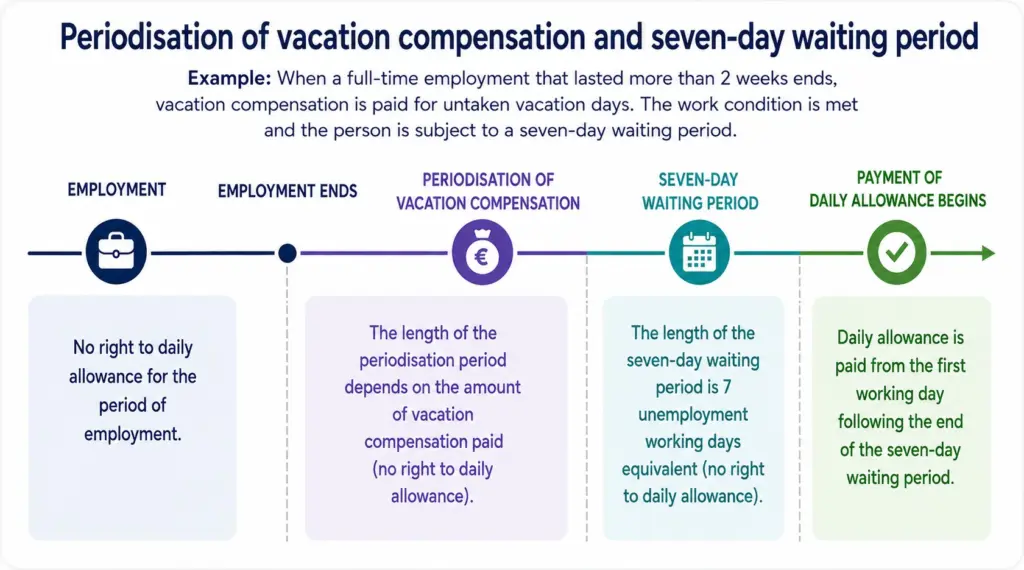
If you are unable to take all your vacation days during your employment, the untaken vacation will be paid as a monetary compensation (lomakorvaus) when your employment ends. If you have worked over 2 weeks in a full-time employment that endsand you are paid monetary compensation for untaken vacation, you are not entitled to unemployment allowance for the period of time for which the vacation compensation received corresponds to as salary. This is called periodisation of the vacation compensation.
- An employment relationship is full-time if the working hours under the employment contract are more than 80% of the normal full-time working hours in the sector. This means that even part-time work is considered full-time for unemployment security purposes if the working hours exceed the 80% limit.
The period for which unemployment allowance is not paid is calculated by dividing the compensation you received by the average salary of that employment.
Example 1: Your employment ends on 7.1. On the payment date of 13.1. vacation compensation is paid for 3 weeks untaken vacation. You have no right to unemployment allowance for a period of approximately 3 weeks (estimated 8. – 28.1.)
The usual seven-day waiting period does not run during the periodisation. Learn more about the seven-day waiting period.
Vacation compensation paid for part-time work or short-term, temporary work is taken into account in the adjustment of the unemployment benefit
If you are paid vacation compensation from a part-time job (working hours max. 80% of full-time hours) or from so-called gig job (a full-time job that last no more than 2 weeks), the vacation compensation is taken into account in the same way as the normal salary from that job. Read more about adjusted unemployment allowance.
- Part-time work refers to work that does not exceed 80% of the normal full-time working hours in the sector. For example, 80% of 37.5 hours is 30 hours.
Vacation compensation for successive employment relationships
As a general rule, monetary compensation for untaken leave (lomakorvaus) is periodized at the end of each period of full-time employment of more than two weeks. However, if you enter into a new employment relationship with the same employer and continue to work immediately after the end of the previous employment relationship, the vacation pay accrued for the entire period of employment is only periodized at the end of the second employment relationship.
Example.
You have an employment contract for the period 9.9.2024 to 24.9.2024. When your employment relationship ends, you are paid vacation compensation for the period of employment. However, you sign a new employment contract with the same employer as of 25.9.2024. Your employment will end on 14.10.2024 and you will apply to the fund for daily allowance from 15.10.2024 onward. The vacation compensation you have earned from both employment contracts will be added together and periodized from 15.10.2024 onward.
Even if the employment relationships are not immediately consecutive, you can agree with your employer that your annual leave benefits accrued before the end of the employment relationship will be carried over to be taken during the next employment relationship. You can do this if you agree on a new employment contract before the end of the previous employment relationship, and at the same time agree to carry over your annual leave days. Please note that the agreement on the carry-over of leave must be in writing. If you have concluded a written agreement and you are paid vacation pay on the basis of two or more employment relationships at the end of your last employment relationship, the periodizing of vacation compensation is calculated on the basis of the total amount of vacation compensation. If the agreement is oral and not in writing, the case-law states that vacation pay must be periodized from the end of the job to which it relates.